

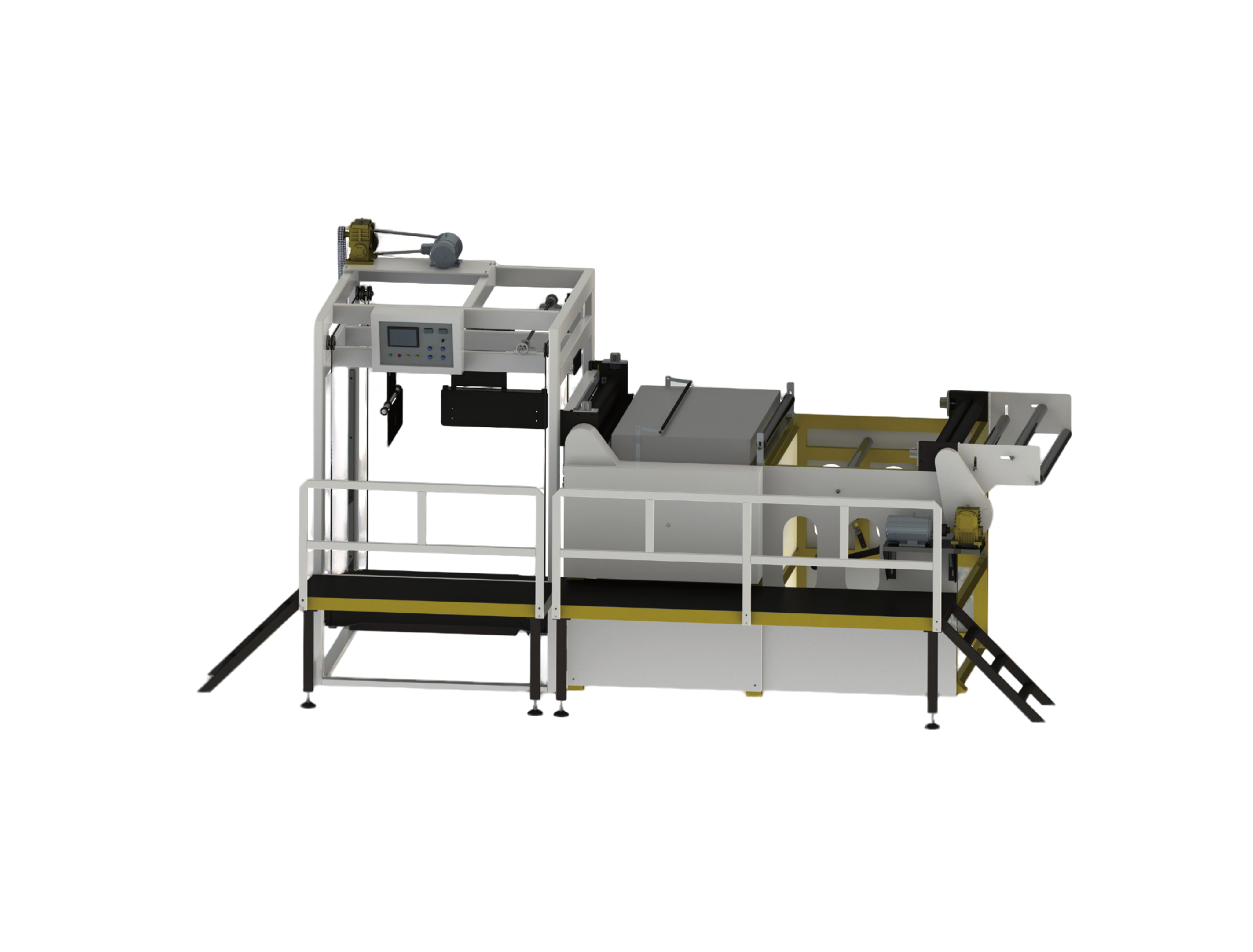
YD1300 shaftless positioning sheeters and YD1400 shaftless positioning sheeters are widely used in paper converting, printing, packaging, and finishing operations where high-precision sheet cutting is required. These machines are designed to convert paper rolls into accurately sized sheets with stable registration, consistent length control, and efficient production output. For businesses searching for reliable roll-to-sheet conversion, understanding the relationship between matching paper rolls and required sheet formats is essential for achieving maximum productivity, reducing waste, and maintaining print quality.
This guide provides industry-standard information about shaftless positioning sheeters, the paper roll specifications they typically handle, the sheet formats they support, and the technical factors that influence performance. The content below is written for use in blog posts, category pages, product-introduction pages, and industry landing pages. It is keyword-rich, SEO-friendly, and structured to support Google indexing.
A shaftless positioning sheeter is a paper converting machine that cuts roll paper into sheets according to preset length and quantity parameters. Unlike traditional shaft-based systems, shaftless models use a more flexible roll-loading structure that simplifies paper roll handling, improves changeover speed, and supports a wider range of roll sizes and paper grades.
The term positioning sheeter refers to the machine’s ability to cut sheets with accurate length control and stable positioning. In industrial use, this accuracy is important for offset printing, digital finishing, carton production, book manufacturing, label support materials, and various packaging workflows.
The YD1300 and YD1400 are common width categories used in shaftless positioning sheeters. The number usually indicates the maximum working width or nominal format capability, making these machines suitable for different roll widths and sheet output requirements.
The popularity of YD1300 shaftless positioning sheeters and YD1400 shaftless positioning sheeters comes from their combination of flexibility, precision, and operational efficiency. They help converters process large paper rolls into custom sheet sizes without requiring complex manual cutting operations.
Selecting the right paper roll is one of the most important steps in successful roll-to-sheet conversion. The machine width alone does not guarantee good performance; the roll characteristics, paper grade, core size, roll diameter, basis weight, and surface condition all influence the final result.
When matching paper rolls to a YD1300 positioning sheeter or YD1400 positioning sheeter, operators should evaluate the following factors:
| Paper Roll Factor | Why It Matters | Typical Consideration |
|---|---|---|
| Roll width | Must fit the machine’s maximum working width | YD1300 and YD1400 categories are selected according to required web width |
| Roll diameter | Influences loading capacity and tension stability | Large rolls require stronger unwinding support and braking control |
| Core inner diameter | Must be compatible with the loading system | Common core sizes vary by paper grade and supplier standard |
| Paper grade | Determines tension behavior and cutting performance | Coated paper, uncoated paper, kraft, board, and specialty grades behave differently |
| Basis weight | Affects stiffness, feed stability, and cutter load | Lighter papers require gentler control; heavier boards require stronger cutting systems |
| Moisture level | Impacts dimensional stability and curl | Stable storage conditions improve sheeting accuracy |
| Surface finish | Influences friction and registration | Smooth, coated surfaces may require tighter tension control |
YD1300 and YD1400 shaftless positioning sheeters can typically work with a broad range of roll-fed paper materials. The exact compatibility depends on machine configuration, cutting system, and tension control settings.
| Paper Roll Type | Common Applications | Compatibility Notes |
|---|---|---|
| Offset paper rolls | Printing, publishing, commercial finishing | Good sheet stability and versatile use |
| Coated paper rolls | High-quality print jobs, catalogs, premium packaging | Requires precise tension and clean cutting |
| Uncoated paper rolls | Books, forms, office products, general printing | Generally easy to process with standard settings |
| Kraft paper rolls | Packaging, wrapping, protective sheets | Usually heavier and stronger; may require robust unwinding |
| Paperboard rolls | Cartons, structural packaging, conversion lines | Needs stronger cutting force and precise alignment |
| Specialty paper rolls | Labels, decorative sheets, technical applications | Should be tested for tension sensitivity and surface behavior |
The required sheet format depends on the end-use application. In industrial sheeting, the sheet format includes sheet width, sheet length, flatness, cut accuracy, and stacking consistency. The sheet dimensions must be compatible with the downstream printing, folding, packaging, or converting process.
Below are common sheet format categories that are frequently produced by YD1300 shaftless positioning sheeters and YD1400 shaftless positioning sheeters.
| Sheet Format Type | Typical Use | Key Requirement |
|---|---|---|
| A4-style sheet format | Office, publishing, printing conversion | High dimensional consistency and accurate cut length |
| A3-style sheet format | Large-format printing, manuals, promotional items | Stable sheet stacking and clean edge quality |
| Custom commercial formats | Special print and finishing requirements | Exact programmable length control |
| Packaging sheet formats | Carton blanks, insert sheets, wrappers | High repeatability and minimal curl |
| Industrial sheet formats | Technical paper, protective layers, specialty conversion | Material stability and reliable feeding |
Although actual format capability varies by machine configuration, the following factors are usually considered when defining sheet size for a YD1300 sheeter or YD1400 sheeter:
The shaftless design offers a number of practical advantages for paper processing and sheet cutting operations. These benefits make shaftless positioning sheeters highly suitable for modern roll-to-sheet production environments.
| Advantage | Industry Benefit |
|---|---|
| Easy roll loading | Reduces labor and shortens setup time |
| Improved roll compatibility | Handles a wide range of paper roll specifications |
| Accurate length positioning | Ensures consistent sheet dimensions and higher output quality |
| Efficient production changeover | Supports shorter job transitions and better line utilization |
| Reduced material waste | Improves yield and lowers cost per sheet |
| Better production flexibility | Supports many paper grades and custom formats |
Sheet quality in a positioning sheeter is affected by several engineering and operational factors. Achieving a clean final sheet requires careful coordination of unwinding, tension control, cutting, and stacking.
Stable web tension prevents wrinkling, drifting, and stretching during feeding. If tension is too high, the paper may deform; if too low, the web may wander or lose registration.
Precision cutting is essential for maintaining consistent sheet length. Accurate servo control or synchronized mechanical timing improves repeatability and minimizes format deviation.
Proper roll alignment helps maintain straight feeding and reduces edge error. Misalignment may lead to uneven cutting or poor stacking quality.
Paper that is too humid, too dry, curled, or damaged may cause feeding instability. Good storage practices help preserve roll quality before processing.
After cutting, sheets must be delivered smoothly into a stack or conveyor system. Clean stacking is especially important for printing and packaging workflows where downstream automation is used.
The table below provides a general reference for YD1300 and YD1400 shaftless positioning sheeters. Actual machine specifications can vary by configuration, but these values represent common industrial reference points.
| Specification Item | YD1300 Category | YD1400 Category |
|---|---|---|
| Nominal working width | Up to approximately 1300 mm | Up to approximately 1400 mm |
| Compatible paper roll types | Offset, coated, uncoated, kraft, specialty paper | Offset, coated, uncoated, kraft, specialty paper |
| Supported sheet formats | Standard and custom sheet sizes within width limit | Standard and custom sheet sizes within width limit |
| Primary function | Roll-to-sheet conversion with positioning control | Roll-to-sheet conversion with positioning control |
| Industrial applications | Printing, packaging, converting, finishing | Printing, packaging, converting, finishing |
| Setup style | Shaftless roll loading | Shaftless roll loading |
| Output emphasis | Accuracy, stability, efficiency | Accuracy, stability, efficiency |
Choosing the correct paper roll depends on the final sheet format and the intended application. For example, a premium print job may need a coated paper roll with excellent surface uniformity, while a packaging line may require a stronger kraft roll for durability.
A practical selection process usually includes the following steps:
These machines are used across several industrial sectors. Their flexible format handling makes them valuable in both high-volume production and customized converting operations.
| Application Area | Typical Sheet Output |
|---|---|
| Commercial printing | Accurate print sheets with stable dimensions |
| Packaging production | Carton blanks, liners, inserts, wrappers |
| Paper converting | Custom-sized roll-to-sheet products |
| Publishing and finishing | Book components, inserts, manual pages |
| Industrial materials processing | Technical sheets and specialty paper formats |
To achieve consistent performance from a YD1300 shaftless positioning sheeter or YD1400 shaftless positioning sheeter, operators should follow proven best practices for setup and maintenance.
For content planning and search optimization, the following keyword phrases are commonly associated with this topic:
Its main function is to convert paper rolls into accurately sized sheets with stable positioning and controlled cutting length.
Common compatible roll types include offset paper, coated paper, uncoated paper, kraft paper, paperboard, and certain specialty papers, depending on machine configuration.
Common output includes standard commercial formats, custom print sheets, packaging blanks, and industrial paper formats.
Shaftless loading simplifies roll installation, speeds up changeovers, and improves operational flexibility.
Key factors include web tension, paper condition, cutter precision, roll alignment, and machine setup quality.
YD1300 and YD1400 shaftless positioning sheeters are important roll-to-sheet conversion machines for modern paper processing operations. By matching the right paper rolls to the required sheet formats, businesses can improve cutting precision, reduce waste, increase throughput, and support a wide range of industrial applications. Understanding paper roll compatibility, sheet size requirements, and machine performance factors is essential for achieving consistent results in printing, packaging, converting, and finishing environments.
For SEO purposes, this topic naturally supports high-value search queries around shaftless positioning sheeters, paper roll matching, required sheet formats, and industrial sheet cutting solutions. It is suitable for use as an on-page content block in a blog article, directory page, category page, or industry information page.
Contact: Peter Chen/Jack Chen
Mail : peterchen@yuedamachine.com
Cellphone: +86 18767458866/ +86 19857780001
Address: Building 2, No. 1333 Times Avenue, Longgang City,Wenzhou City, Zhejiang Province China
Copyright © 2026 Wenzhou Yueda Packaging Machinery Co., Ltd. All Rights Reserved.
SitemapThis website uses cookies to ensure you get the best experience on our website.
 Español
 Portugues
 Indonesia
 Tiếng Việt



 Phone
 E-mail
Comment
(0)